


Ever wondered how much it really costs to send a parcel across Australia? A shipping cost calculator is your answer. It's a smart online tool that instantly estimates the price, saving you from the classic headache of undercharging a customer or overpaying at the post office.
Think of it like a travel booking site that compares flights. You punch in your destination and dates, and it immediately pulls up the best options. A shipping calculator does the exact same thing, but for your packages.
How a Shipping Cost Calculator Really Works

Instead of manually digging through different courier websites or trying to guess the cost, this tool acts as your personal logistics expert. It crunches all the tricky variables—distance, size, weight, and delivery speed—and gives you a clear, upfront price. This is absolutely essential for anyone who needs to know the cost before they ship.
The Power of Instant Comparison
The real magic of a modern shipping cost calculator is its ability to compare multiple couriers in one go. You might be surprised to learn how much the price to send the same parcel from Sydney to Perth can differ between carriers. By gathering real-time data from a whole network of providers, the calculator lets you:
- Pinpoint the cheapest rate for your specific delivery, no guesswork involved.
- Save a huge amount of time by seeing all your options in one place, in seconds.
- Dodge nasty surprises by getting a full quote that already includes things like fuel levies and other surcharges.
Think of it this way: a calculator removes the friction and uncertainty from shipping. It turns a tedious manual chore into a simple, two-minute task, making sure you get the best bang for your buck on every single parcel.
Making Sense of Complex Shipping Rules
A good calculator is programmed to understand the complicated pricing structures that different couriers use—rules that are often buried in the fine print and too complex for most of us to bother with. It mirrors the real-world conditions laid out in company guidelines, like in Easy Inflatables' detailed shipping policy.
For any Australian business, this is a game-changer. It means you stop losing money by accidentally underquoting shipping costs. And for the rest of us, it means we’re not paying more than we need to when sending a birthday gift interstate. It’s all about giving you transparency and control.
Want to see it in action? Give our instant Australian shipping rate calculator a try and see just how fast you can get a quote for your next delivery.
Understanding What Drives Your Shipping Price
To really get the most out of a shipping cost calculator, it helps to look under the bonnet and see what’s actually driving the price. It's not just about how far a parcel is going; a whole host of factors come together to generate that final quote. Once you get a handle on these, you can start making smarter shipping decisions that can seriously lower your costs.
The biggest concept to wrap your head around is the constant tug-of-war between two types of weight: actual weight and cubic weight. This one idea is often the reason shipping costs can feel a bit strange, especially for bulky but light items.
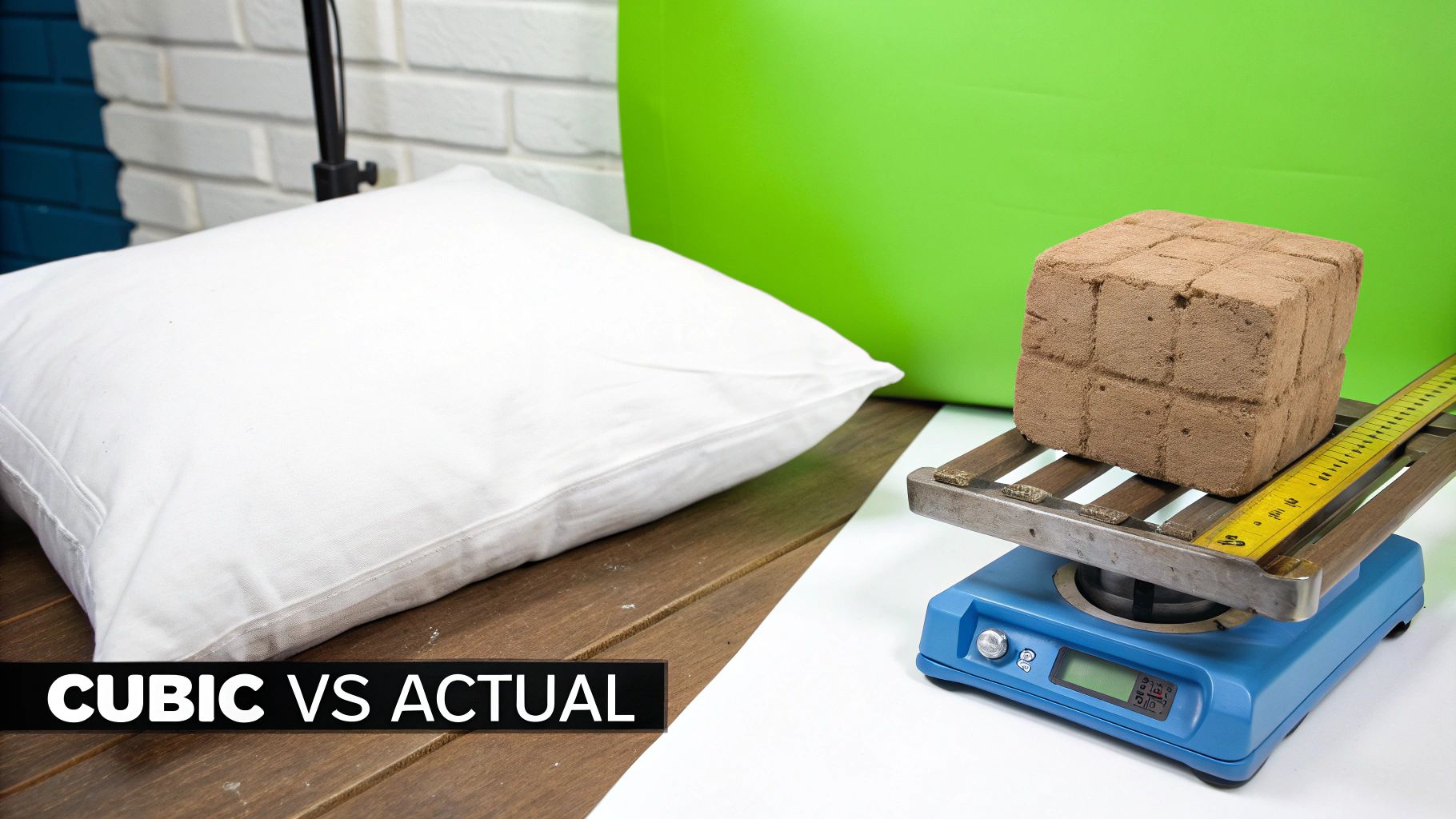
The Pillow vs. The Brick: The Great Weight Debate
Let's imagine you need to ship two very different items. The first is a small, heavy brick that tips the scales at 10 kilograms. The second is a huge, fluffy pillow that weighs just 1 kilogram. Which one costs more to send? Most people would bet on the brick, but more often than not, it's the pillow that's going to hit your wallet harder.
Why? Because a courier's van or truck only has so much space. A carrier isn't just worried about how heavy something is, but how much room it chews up. That big pillow, as light as it is, takes up valuable real estate that could otherwise fit dozens of smaller, heavier packages.
This is the golden rule of freight pricing: couriers charge for the space an item consumes just as much as its physical weight. A reliable shipping cost calculator has to crunch the numbers for both to give you a price you can count on.
This brings us to the two key metrics every single Australian courier lives by.
- Actual Weight: This is the easy one. It’s simply what your parcel weighs when you pop it on a set of scales, measured in kilograms (kg).
- Cubic (or Volumetric) Weight: This is a bit different. It’s a calculation that turns your parcel’s volume into an equivalent weight, essentially measuring how much space it occupies.
To make sure they're paid fairly for moving both heavy and bulky items, Australian couriers will always charge you based on whichever of these two weights is greater.
Calculating Cubic Weight: The Australian Formula
So, how do you work out this space-based weight? It’s a simple formula that lies at the heart of every Australian shipping calculator.
The standard industry formula is: Length (m) × Width (m) × Height (m) × 250.
Let's go back to our pillow example. Say it’s packed in a box measuring 0.5m x 0.5m x 0.4m. The calculation would be:
0.5m (L) x 0.5m (W) x 0.4m (H) x 250 = 25 kg
Even though the pillow's actual weight is a measly 1 kg, its cubic weight is a massive 25 kg. The courier is going to charge you based on that 25 kg figure, no question. For businesses handling unique or large items, like those involved with shipping pizza prep tables and restaurant equipment, mastering this calculation is absolutely essential.
This is exactly why punching in accurate dimensions into a shipping cost calculator is a must for getting a trustworthy quote. If you need a hand with the maths, check out our simple guide to calculate cubic weight for any parcel.
How Different Factors Impact Your Shipping Quote
To see how these variables work in the real world, let's look at a hypothetical parcel. Our baseline is a 5 kg box (0.3m x 0.2m x 0.2m) heading from a metro address in Sydney to a metro address in Melbourne. The original quote is $15.20.
Here’s how small changes can affect the final price:
| Variable Changed | Original Quote (Sydney to Melbourne Metro) | New Quote | Reason for Change |
|---|---|---|---|
| Increased Weight | $15.20 | $22.50 | The parcel is now 10 kg, so the higher actual weight increases the base shipping cost. |
| Increased Dimensions | $15.20 | $28.10 | The box is now 0.5m x 0.3m x 0.2m. The cubic weight is now 7.5 kg (higher than actual), making it the chargeable weight. |
| Remote Delivery | $15.20 | $35.40 | Sending the same parcel to a remote WA address requires more resources, significantly raising the cost. |
| Express Service | $15.20 | $41.80 | Choosing an overnight Express service prioritises speed, which comes at a premium price. |
As you can see, the final cost is a delicate balance of multiple factors. Changing just one can have a surprisingly big impact on your quote.
Other Key Factors Influencing Your Quote
While the weight debate is central, a few other things have a big say in your final shipping price here in Australia.
- Delivery Distance and Location: It's not just about the kilometres between postcodes. Couriers split the country into zones (metro, regional, remote). Getting a parcel to a remote town will always cost more than a quick trip across the city.
- Service Speed: Do you need it there tomorrow or can it wait a few days? An express or overnight service will naturally cost more than a standard road freight option, which is slower but much more budget-friendly.
- Packaging Choices: The box you pick is a big deal. Using an unnecessarily large box inflates your cubic weight and often means using more filler material, which can bump up the actual weight too. It's a double whammy.
- Potential Surcharges: Keep an eye out for extra fees. Couriers can add surcharges for things like delivering to a residential address, handling parcels that are unusually large or heavy, or items that need special care.
Getting an Accurate Quote in 5 Simple Steps

Using a shipping cost calculator is pretty straightforward, but the quality of your quote depends entirely on the quality of the information you put in. Think of it like a recipe—if you guess the measurements, the final dish just won't turn out right.
To make sure the price you see is the price you pay, just follow these five simple steps. This process works for just about any calculator for shipping within Australia, helping you dodge those common mistakes that lead to surprise fees and frustrating re-invoices from couriers.
Let's break down how to get a reliable quote in just a few minutes.
Step 1: Enter Pickup and Delivery Postcodes
This is your starting point—the most fundamental piece of the puzzle. The calculator uses these postcodes to figure out the distance and shipping zones, which are the biggest factors influencing the cost.
- Be specific: Don't just type in the city. You need the exact postcode for both the sender and the receiver. A parcel going from Sydney 2000 to Melbourne 3000 is priced differently than one going from Parramatta 2150 to a regional town in Victoria.
- Identify the address type: Is it a business or a home? Make sure you specify, as many carriers tack on a surcharge for residential deliveries.
Getting this right lays the foundation for everything else.
Step 2: Measure and Weigh Your Parcel Accurately
Honestly, this is where most costly mistakes happen. Guessing your parcel’s dimensions or weight is a fast track to an inaccurate quote and, often, a penalty fee down the line. Don’t forget about cubic weight—couriers will always charge based on whichever is greater, the actual weight or the volumetric weight.
Pro Tip: Never, ever estimate your parcel's measurements. A tiny error of just a few centimetres can easily bump your shipment into a higher price bracket, turning what looked like a profitable sale into a loss.
To nail the accuracy, here’s what you need to do:
- Use the Right Tools: A simple measuring tape for dimensions and a reliable scale for weight are non-negotiable. For smaller items, a digital kitchen scale is perfect. For bigger boxes, a standard bathroom scale will get the job done.
- Measure the Final Packed Box: This is crucial. Always measure the box after it’s been fully packed and sealed, not the item inside it. The outer dimensions are what the courier’s scanners will capture.
- Always Round Up: If your measurement comes to 25.4 cm, round it up to 26 cm. Courier systems don't bother with fractions, and that little bit of buffer helps you avoid disputes if their scanners measure things slightly differently.
Step 3: Select the Correct Freight Type
Not all shipments are the same, and the calculator needs to know what you're sending to apply the right handling rules and pricing.
On any good Australian shipping cost calculator, you'll usually see these options:
- Carton/Box: The standard choice for most parcels.
- Satchel/Bag: Ideal for documents or small, soft items that fit in a courier bag.
- Pallet/Skid: Used for large, bulk business shipments that are shrink-wrapped onto a wooden pallet for forklift handling.
Choosing the wrong freight type can lead to your quote being rejected or, even worse, the driver refusing to pick up the item.
Step 4: Choose Your Service Level
How fast does it need to get there? The delivery speed you pick has a massive impact on the final price.
Typically, you’ll have to choose between two main options:
- Standard/Road Express: This is your most budget-friendly option, perfect for anything that isn’t time-sensitive. Transit times are longer, but the savings can be huge.
- Express/Overnight: This is the premium service for urgent parcels that need to arrive the next business day in most metro areas.
Just pick the service that strikes the right balance between your budget and your deadline.
Step 5: Review and Compare Your Quotes
After you've entered all your details, the shipping cost calculator will show you a list of options from different carriers. It’s tempting to just grab the cheapest one, but take a moment to look closer.
Review all the details, including the estimated transit times and any extras like included insurance. This final step is what allows you to make a smart, informed decision that truly fits your needs.
By following these steps, you can confidently calculate shipping charges knowing your quote is built on solid, accurate data.
Avoiding Common and Costly Shipping Mistakes
Even the best shipping cost calculator is only as reliable as the details you put into it. It's easy to make small, seemingly innocent mistakes when you're in a hurry, but those little errors can quickly spiral into unexpected fees, annoying delays, and even disputes with carriers.
Knowing what these common traps are is the secret to making sure the price you see on the screen is the price you actually pay. Most of these slip-ups come from simple oversights, but their impact on your budget can be huge. By just taking a few extra moments to get the details right, you can save yourself a lot of money and headaches down the track.
Let’s walk through the most common and costly mistakes people make when shipping around Australia and, more importantly, how you can sidestep them.
Mistake 1: Guessing Dimensions and Weight
This is, hands down, the biggest reason for shipping cost blowouts. Just eyeballing a box and thinking, "that looks about 30 cm," is a recipe for a nasty surprise. Courier depots don't guess; they use automated, laser-guided systems that measure and weigh every parcel with pinpoint accuracy.
When their scanners find a difference between what you declared and the actual size, you’ll get hit with a re-invoice for the extra cost, often with a penalty fee slapped on top.
- How to Fix It: Simple – use a measuring tape and scales. Always measure your box after it's been packed and sealed. A good rule of thumb is to round every measurement up to the next whole centimetre (so, 25.4 cm becomes 26 cm). This little bit of buffer covers any slight bulges from packing and protects you from any discrepancies.
Mistake 2: Ignoring Cubic Weight
Forgetting about cubic weight can be an expensive lesson, especially if you’re sending large but lightweight items. Think big boxes of pillows, lampshades, or foam packaging. If you only enter the actual weight and ignore the dimensions, the initial quote will look fantastic—but it will be completely wrong.
As we covered earlier, Australian carriers always charge based on whichever is greater: the actual dead weight or the cubic weight.
An inaccurate declaration isn't just a minor slip-up; it's a direct ticket to unexpected charges. Carriers run routine audits, and their systems automatically flag any inconsistencies, leading to a bill adjustment that might not show up until days or even weeks after your item has been delivered.
- How to Fix It: Never, ever skip entering the dimensions into the shipping cost calculator. The tool is built to do the hard work for you. It automatically calculates the cubic weight, compares it to the actual weight, and gives you a quote based on the correct chargeable weight.
Mistake 3: Choosing the Wrong Freight Type
This one causes immediate logistical chaos. Selecting "carton" when you're really sending a pallet (or the other way around) is a showstopper. The freight type tells the courier what kind of vehicle and equipment they need to bring for the pickup.
Imagine the driver turning up in a small van expecting to grab a box, only to find a 200 kg pallet sitting there. They simply won't be able to take it. The pickup will be marked as "futile," and you'll have to cancel, re-book, and start the whole process over again, wasting a whole day.
Here’s a quick rundown of the basics in Australia:
-
Satchel: For documents or very small items that fit in a courier bag.
-
Carton/Box: Your standard choice for most general goods.
-
Pallet/Skid: For large, bulk goods stacked and secured on a pallet, ready for a forklift.
-
How to Fix It: Before you click that "book" button, just take a second to double-check you've selected the right freight type for your shipment. If you’re ever in doubt, it’s always smarter to ask your courier platform for advice. This simple check prevents failed pickups and the drama that comes with them.
Optimising Shipping Costs for Your Australian Business

For any Aussie business selling products online, shipping isn't just a cost—it's a massive part of the customer experience and a direct hit to your bottom line. Once you move past sending the odd parcel here and there, a shipping cost calculator stops being a simple tool and becomes a genuine competitive advantage.
Forget being stuck with one carrier's rates. Using a multi-carrier platform lets you shop around for the best deal on every single package you send. This isn't just about finding a price; it’s about finding the best price for that specific parcel and destination, which directly protects your profit on every sale.
From Expense to Strategic Advantage
The first mental shift is to stop seeing shipping as a fixed overhead and start treating it as a cost you can actually control. Every dollar you save on freight is a dollar that lands right back in your pocket or gets reinvested into growing the business.
This is where a good shipping cost calculator really shines. Online tools have completely changed the game for small and medium businesses in Australia. In fact, platforms like Aeros Couriers that give you instant, comparative quotes can help businesses slash their shipping expenses by up to 30% by unlocking access to wholesale rates.
It's all about making your business more agile. You can react to changes in carrier pricing and service options without being locked into a rigid contract.
Actionable Strategies to Lower Your Shipping Spend
Getting a better rate is a great start, but it's not the whole story. True cost optimisation comes from being smarter about how you pack and send your orders. With a few key changes, you can actively reduce the chargeable weight and, in turn, the final cost of your shipments.
Here are some practical, high-impact tactics you can start using today:
- Optimise Your Packaging: Don't use a box that's way too big for the item. All that empty space not only drives up the cubic weight but also means you’re paying for extra void-fill material that adds to the actual weight. Keep a variety of box sizes on hand to get a snug fit.
- Consolidate Your Shipments: If a customer places a few separate orders going to the same address, bundle them into a single, larger shipment. It's almost always cheaper than sending multiple small packages and it’s better for the environment, too.
- Pre-Pay and Save: Many courier platforms offer slightly better rates if you pre-pay for services or top up an account balance. These small savings might not seem like much at first, but they really add up over hundreds or thousands of shipments.
The goal is to make your parcels as small and dense as possible. By minimising wasted space, you directly combat the impact of cubic weight, which is often the biggest driver of high shipping costs for e-commerce goods.
Leveraging Technology for Better Rates
Beyond your packing bench, the right technology platform can unlock some serious savings. Modern multi-carrier systems don't just compare prices; they give you access to discounted rates that were traditionally only available to massive, high-volume shippers.
This levels the playing field, allowing a small startup in Adelaide to get similar shipping discounts to a big corporation in Sydney. By pooling the shipping volume of thousands of small businesses, these platforms can negotiate bulk rates with carriers and pass those savings straight on to you.
Cost Optimisation Strategies for Australian Businesses
Here’s a quick summary of practical tips that Aussie businesses can use to cut down their shipping expenses and boost their efficiency.
| Strategy | Primary Benefit | Implementation Tip |
|---|---|---|
| Real-Time Rate Comparison | Instantly find the most cost-effective carrier for every single parcel. | Use a multi-carrier platform like Aeros Couriers to compare quotes from multiple providers in seconds. |
| Packaging Optimisation | Reduce chargeable cubic weight, the most common cause of high costs. | Invest in a range of box sizes to ensure a snug fit and minimise the use of void-fill materials. |
| Shipment Consolidation | Lower the cost-per-item by combining multiple orders into one delivery. | Use your order management system to flag multiple orders going to the same customer address. |
| Accessing Discounted Rates | Benefit from bulk-rate discounts without needing a high-volume contract. | Choose a platform that offers wholesale pricing to all users, regardless of their shipping frequency. |
Ultimately, taking a proactive approach to managing your freight transforms it from a necessary evil into a powerful tool for growth. When you consistently seek out the most efficient and affordable delivery methods, you not only boost your profits but also make your customers happier with reliable, low-cost shipping. For more ideas, check out our guide to finding the cheapest courier service in Australia.
Your Top Questions About Shipping Calculators, Answered
Even after getting a good grip on how a shipping cost calculator works, it's natural to have a few more questions pop up. To help clear things up, we’ve tackled some of the most common queries we get from people and businesses shipping parcels across Australia.
Think of this as your practical cheat sheet for using these tools like a pro. Let’s get you shipping smarter.
How Accurate Are Online Shipping Cost Calculators in Australia?
Online shipping calculators are incredibly precise, but with one important caveat: their accuracy is only as good as the information you feed them. It's a classic case of "garbage in, garbage out." If you punch in the exact details, you'll get an exact quote.
These tools aren’t just making educated guesses; they're plugged directly into the live pricing systems of Australian carriers. When there's a mismatch between the quoted price and the final bill, it almost always comes down to a small error during data entry.
To nail your quote every single time:
- Always use a measuring tape for the final dimensions of your packed box. Don't eyeball it.
- Weigh the parcel on a proper scale. A kitchen or bathroom scale will do the trick.
- Double-check the pickup and delivery postcodes. A single wrong digit can make a big difference.
A little bit of precision up front means the price you see is the price you pay. No surprises.
Why Does My Large but Lightweight Item Cost So Much to Ship?
This is a fantastic question, and the answer is all about a concept we touched on earlier: cubic weight. Couriers in Australia don't just charge for how heavy something is; they charge for the amount of space it takes up in their van or plane. A bulky item, like a big fluffy cushion or a delicate lampshade, means they can't fit other parcels around it.
For every single parcel, carriers in Australia calculate two different weights:
- Actual Weight: This is simply what the item weighs on the scales.
- Cubic Weight: This is a value calculated from the parcel's dimensions (Length x Width x Height x 250).
They will always charge you for whichever of those two figures is greater. A good shipping cost calculator handles this for you instantly, which is exactly why providing dead-on accurate dimensions is crucial for getting a reliable quote, especially for those larger items.
Can I Get an Instant Quote Without an Account?
Yes, you certainly can. Most modern shipping platforms in Australia are built for speed and convenience, letting you get an instant quote without signing up or making any commitment. It’s perfect for when you need to quickly check costs before listing something for sale online, or for those one-off shipments you only send once in a blue moon.
Many platforms, including Aeros Couriers, have a calculator right on their homepage. This lets anyone get a fast, no-obligation comparison of shipping options in under a minute, removing any hassle for first-time shippers.
This open-door approach makes it incredibly easy to budget for shipping costs without having to hand over your details until you’re actually ready to book.
Does the Calculator Always Show the Cheapest Shipping Option?
A quality multi-carrier shipping cost calculator is specifically designed to hunt down the cheapest possible option for your specific parcel and route. It saves you the trouble of having to jump between the websites of every individual courier.
When you enter your parcel’s details just once, the system polls multiple Australian carriers in its network. It then pulls all the real-time quotes together and lays them out for you in a simple list, usually sorted from the lowest price to the highest. This not only saves you a heap of time but often unlocks access to discounted or wholesale rates you wouldn't find by going directly to the carrier.
To see this in action, feel free to explore the options available through our own comprehensive shipping fee calculator. It’s built to pinpoint the most cost-effective solution for your delivery needs anywhere in Australia, ensuring you get the best value for money every time.
Ready to put all this knowledge to good use and find the best shipping rates for your parcels? The Aeros Couriers platform makes it simple. Get an instant, obligation-free quote in seconds and see how much you could save on your next Australian delivery. Click here to get your instant quote now!
